


Key Takeaways
For UK property developers, main contractors, and architects working on low- to mid-rise projects, modern steel framing now delivers clear structural advantages over traditional timber construction. Here’s what you need to know before specifying your next project:
Modern UK light gauge steel framing and hot-rolled steel framing systems provide significantly higher strength-to-weight ratios than wood, enabling longer spans, slimmer walls, and greater design flexibility across residential buildings, student accommodation, and commercial schemes.
Steel’s predictable, consistent performance under wind, snow, and occupancy loads reduces structural risk compared with the variable quality of softwood commonly used in UK housebuilding – where knots, grain direction, and moisture content can all affect strength.
Steel is inherently non-combustible, dimensionally stable, and resistant to rot, insects, and warping, which translates to fewer long-term defects and reduced call-backs versus timber frames.
A fully accredited UK-based steel framing company can offer engineered systems designed to Eurocodes and UK Building Regulations, giving specifiers confidence and supporting compliance from concept through handover.
Whole-life performance matters: steel’s durability and recyclability make it a strong choice for projects targeting net-zero carbon and offsite construction strategies in the UK construction industry.
What Is Modern Steel Framing? (and How Does It Compare to Wood?)
Modern steel framing systems use light gauge cold-formed steel studs and tracks – often combined with hot-rolled primary structure elements – to create loadbearing and non-loadbearing walls, floors, and roofs in UK buildings. The stud is a key component in both infill and load-bearing applications, valued for its high strength and lightweight nature, which enables rapid, cost-effective, and precise construction. Unlike traditional stick-built timber, these lightweight steel framing systems are factory-engineered to precise tolerances and delivered ready for rapid assembly on site.
In UK residential and low-rise commercial projects, timber frame construction traditionally relies on softwood studs, joists, and rafters. Modern light steel framing replaces these with galvanised steel sections that are manufactured to exact specifications, often modelled in BIM software like Tekla or Revit before a single component reaches the site. Steel framing systems are frequently used as an infill system between primary structural elements, supporting both internal partitions and external facades for greater design flexibility and speed.
Both framing system types serve as the building’s skeleton, but the engineering approach differs significantly. Steel frames are designed from the outset to meet specific loads and performance requirements, whereas timber design often relies on standard details with adjustments made on site. This difference becomes critical when dealing with complex openings, service risers, or the need for clear floor space in apartments and commercial settings.
Typical UK applications for steel framing include:
Apartments and residential buildings from 4 to 10 storeys
Student accommodation and purpose-built rental schemes
Hotels, care homes, and offices
Schools, modular housing, and mixed-use podium developments
Infill walling in steel framing systems is commonly used to create partitions between structural beams or columns, offering a lightweight and adaptable solution that speeds up construction and allows for flexible design options.
Timber frame remains more common in low-rise housing estates and smaller extensions. However, when a recent 6-storey residential block in the Midlands needed to achieve longer corridor spans and minimise wall thicknesses for usable floor area, the developer chose light gauge steel over a timber alternative being used on a neighbouring estate. The result was slimmer external walls, fewer internal loadbearing partitions, and a faster construction process overall.
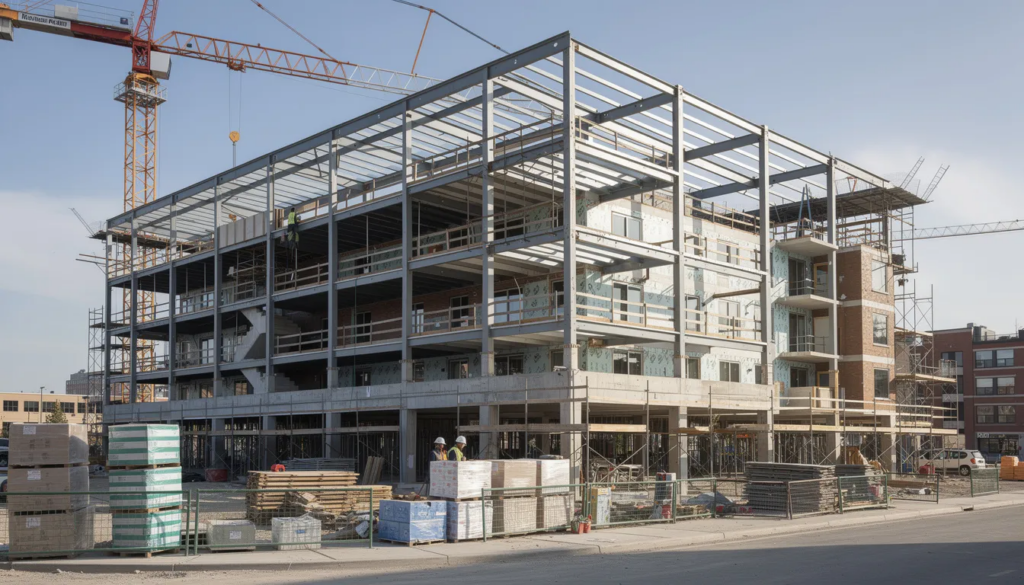
Tracks and other components in steel framing systems are designed for efficient assembly and performance. Slotted head tracks are often used to accommodate deflection and provide structural support for internal and external wall finishes during installation.
Material Strength: Why Steel Outperforms Timber Structurally
The concept of strength-to-weight ratio is central to structural design. A material that can carry more load relative to its own weight allows engineers to use slimmer, lighter components – reducing foundation loads, freeing up internal space, and simplifying construction logistics.
Structural steel typically has yield strengths in the range of 250–460 MPa. UK construction softwood, by contrast, has characteristic bending strengths roughly an order of magnitude lower. This fundamental difference means steel sections can be far more compact while carrying equivalent or greater loads than timber equivalents.
In practical terms, steel studs in walls can be slimmer and lighter than chunky timber studs, yet still provide full load bearing capacity. This directly translates to more usable floor space in corridors, bathrooms, and service risers – areas where every centimetre counts in apartment and commercial schemes.
Steel also behaves predictably. Its properties are consistent in all directions (isotropic), allowing engineers to design with precision to Eurocode 3. Timber strength varies with grain direction, knots, and moisture content, requiring higher safety margins and more conservative design assumptions.
Span capability comparison:
Steel floor joists or cassette floors can sensibly span 4–5 metres or more at modest depths, creating open-plan living areas without intrusive internal beams
Equivalent timber joists at the same depth would typically require intermediate support or significantly deeper sections
For a 4.5m open-plan living space in a UK apartment, steel cassette floors can achieve the span cleanly, while standard timber joists would often need a dropped beam or loadbearing wall
This difference matters for architects designing modern, flexible layouts and for developers seeking to maximise saleable floor area in competitive urban markets.
Performance Under Real-World Loads: Wind, Fire and Long-Term Movement
Buildings in the UK must cope with wind from Atlantic storms, fire regulations under Approved Document B, and long-term issues like shrinkage and settlement. Steel and wood behave very differently under each of these conditions, with significant implications for structural integrity and compliance.
Wind and lateral loads
Steel’s higher stiffness and the ability to form rigid diaphragms and braced bays means less racking and sway than timber structures. This advantage is particularly important for buildings in coastal or exposed locations – the South West, Scotland, or high-rise schemes in city centres where wind loads are significant design factors. Steel components can be precisely connected using screws, bolts, or welded fixings to create a robust framework that resists lateral forces with minimal deflection.
Fire performance
Steel is non-combustible. It does not contribute fuel in a fire, which simplifies fire strategy and insurance considerations. Designers focus on protecting steel’s strength through fire-resisting boards and encasement, rather than worrying about the frame itself catching fire.
Timber, by contrast, is combustible and must be carefully detailed to meet UK fire and insurance requirements – especially for buildings above 11 metres, where post-Grenfell regulations have increased scrutiny. Quantitative fire tests show steel assemblies achieving 120-minute integrity, compared with 30–60 minutes for typical timber construction.
Long-term movement
Timber shrinks, swells, and creeps with moisture changes. The result is often cracked plasterboard, squeaky floors, doors that bind, and finishing defects that require remediation after handover. Steel is dimensionally stable and does not warp or twist, reducing defects and snagging visits for developers and contractors.
Insurers, warranty providers, and lenders – including NHBC and LABC Warranty – are increasingly scrutinising combustible structures. Using steel framing can simplify compliance and underwriting, particularly in mid-rise residential schemes where fire strategy is under close review.
Durability, Moisture and Biological Resistance: Steel vs Timber in the UK Climate
The UK’s damp, variable climate subjects building materials to repeated wetting and drying cycles. How the primary structure responds to these conditions has significant implications for long-term performance and maintenance.
Modern light gauge steel framing uses galvanised steel with coatings such as Z275 or Z600, providing robust corrosion resistance when correctly detailed and kept within the dry zone of the building envelope. UK industry guidance supports a 50–60 year design life for well-specified light steel framing in residential buildings.
Timber, however, is susceptible to rot, fungal decay, insect attack, and mould when moisture content stays above safe levels. Poorly controlled detailing around balconies, flat roofs, and bathrooms can compromise timber structures, sometimes with hidden degradation that only shows up in surveys years later. Wood-boring beetles and other pests can weaken timber over time – a risk that simply does not apply to steel.
Steel does not support mould or biological growth. It cannot be eaten by insects. This baseline resistance reduces the risk of hidden structural problems and gives clients, warranty providers, and lenders greater confidence in the building’s longevity.
Consider a coastal apartment development where driving rain and salt air are constant concerns. Using steel framing helps avoid the historical issues seen in older timber-framed properties exposed to these conditions, where rot and decay in concealed areas led to costly remediation decades after completion.
Correct detailing and cavity design remain essential for both materials. But steel provides a more robust baseline in damp conditions, particularly for projects in exposed locations or with complex external walls and cladding systems.
Design and Architecture Possibilities with Modern Steel Framing
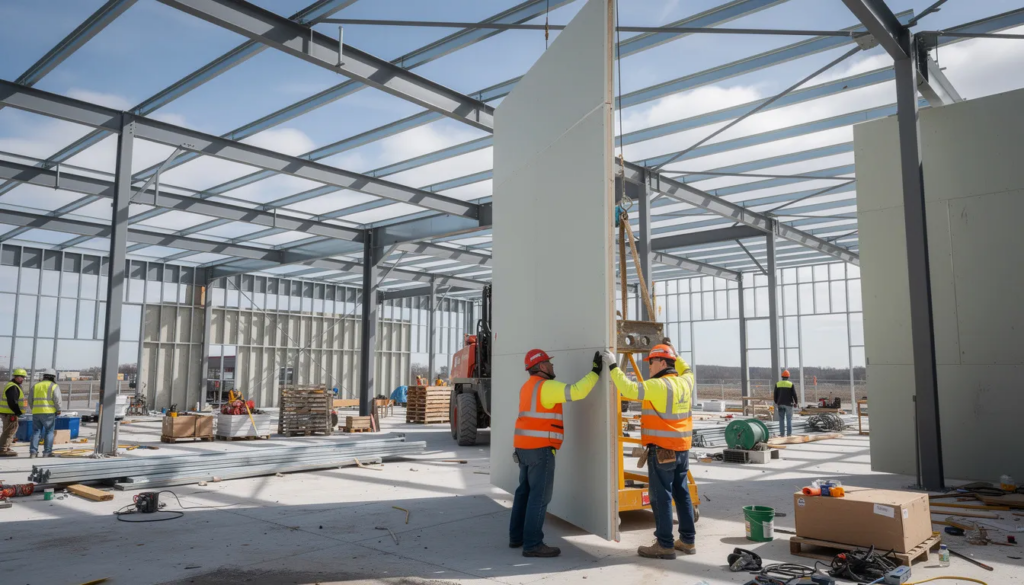
Modern steel framing systems have revolutionised what’s possible in building design, offering architects and developers a level of flexibility and creativity that traditional materials simply can’t match. Thanks to the inherent strength and versatility of lightweight steel framing systems, the construction industry can now deliver bold architectural forms, expansive open-plan layouts, and innovative building envelopes – all while maintaining cost effectiveness and structural integrity.
One of the standout advantages of steel framing systems is their ability to span long distances without the need for frequent intermediate supports. This means designers can create larger, uninterrupted floor spaces – ideal for contemporary residential buildings, student accommodation, and commercial offices where open, adaptable interiors are in high demand. By using steel components in external walls and load bearing elements, it’s possible to achieve slimmer wall profiles, maximising usable floor space and allowing for more daylight and flexible room arrangements.
The modular nature of steel framing systems also supports a wide range of architectural styles and building types. Whether the project calls for dramatic cantilevers, curved facades, or complex roof forms, steel’s precision-manufactured components can be configured to suit almost any vision. This makes steel framing a go-to solution for developers looking to create standout student accommodation, cost-effective commercial spaces, or high-performance residential schemes.
Furthermore, the lightweight properties of modern steel systems simplify the construction process, reducing the load on foundations and making them suitable for challenging sites or rooftop extensions. The result is a construction solution that not only meets demanding structural requirements but also empowers architects to push the boundaries of design, delivering buildings that are both functional and visually striking.
Construction Accuracy, Speed and Defect Reduction
Structural strength on paper only delivers real-world benefits if the frame is built accurately. Modern UK steel framing leverages factory precision to outperform traditionally constructed timber in both consistency and quality.
Steel studs, tracks, and panels are roll-formed to precise lengths – often to the millimetre – and assembled as pre-panelised systems in factory conditions. This approach minimises human error, site waste, and the need for hand-cutting compared with timber that is typically cut to size on site.
Straight, dimensionally stable steel sections stay true during and after installation. Walls are flatter, floors are more level, and there is less need for packing, planing, or adjustment compared with timber that can twist, bow, or warp even while stored on site before assembly.
This precision translates directly into fewer finishing defects:
Better-fitting kitchens and bathrooms
Less cracking at junctions between walls and ceilings
Reduced snagging visits for developers and contractors after handover
Happier clients moving into homes and commercial spaces that feel well-built
Key on-site benefits of pre-engineered steel framing:
Lighter components: Easier to handle and install, reducing manual handling risks
Clear labelling: Factory-applied identification means faster, more accurate assembly
Drier build: Less moisture trapped in the structure compared with wet trades in timber and masonry
Reduced site waste: Pre-cut, pre-drilled components minimise offcuts and disposal costs
Programme benefits are significant. Pre-engineered steel framing can shorten the structural frame installation by weeks compared with traditional timber in UK multi-unit schemes. Earlier weather-tightness means follow-on trades – M&E, drylining, fit-out- can start sooner, accelerating the overall project and improving cash flow for contractors and developers alike.
Finish and Coating: Enhancing Longevity and Aesthetics
The finish and coating applied to steel framing systems are critical factors in ensuring both the longevity and visual appeal of a building. High-quality finishes protect steel components from corrosion, weathering, and everyday wear, helping to maintain the structural integrity of the framing system over decades of use. This is especially important in the UK climate, where moisture and environmental exposure can challenge even the most robust construction materials.
A wide range of finishes and coatings are available to suit different project needs. Galvanised coatings, for example, provide a durable barrier against rust and are a standard choice for many steel framing systems. For projects where aesthetics are a priority, powder-coated finishes offer a smooth, attractive surface that can be colour-matched to complement any architectural style. These coatings not only enhance the appearance of steel components but also add an extra layer of protection, ensuring the framing system remains both functional and visually appealing.
Clients can choose from a variety of suitable finishes to achieve the desired look and performance for their building. Many steel framing system manufacturers are committed to sustainability, offering environmentally-friendly coating options that reduce the overall carbon footprint of the project. By selecting the right finish and coating, developers and contractors can deliver a solution that stands the test of time – minimising maintenance, supporting long-term durability, and ensuring the building continues to look its best for years to come.
Ultimately, the careful selection of finishes and coatings is a key part of delivering high-quality steel framing systems that meet the expectations of clients, enhance the value of the property, and contribute to the overall success of the construction project.
Sustainability and Whole-Life Structural Performance
Structural strength and sustainability are linked. A stronger, more durable frame often delivers better whole-life carbon performance, especially when it avoids early replacement or major structural repairs.
Structural steel is highly recyclable. In the UK and across the EU, recycling rates exceed 90%, and steel from demolished buildings is routinely reused or recycled into new products. Timber is technically renewable, but may be contaminated with treatments, fixings, and finishes that limit reuse and can lead to energy-from-waste or landfill rather than genuine recycling.
Steel’s durability and resistance to moisture-related decay reduce the likelihood of structural replacement during a building’s design life. This locks in the embodied carbon already spent on manufacturing and erection, avoiding the need for additional structural materials later. For clients focused on whole-life carbon assessments, this is an important consideration.
Modern steel framing systems can also be designed to work with high-performance insulation and airtightness strategies. This enables low-energy buildings that meet or exceed current Part L requirements and anticipated Future Homes Standard targets. Steel’s dimensional stability helps maintain airtightness over time, whereas timber movement can open gaps around windows, doors, and service penetrations.
For credible sustainability references, the Steel Construction Institute (SCI) and independent European guidance provide useful resources. These support EEAT by offering third-party data rather than relying solely on manufacturer claims.
Steel framing is fully compatible with net-zero and offsite construction strategies in the UK. As the construction industry moves toward modular, low-waste methods, steel’s precision and recyclability position it as a solution for the future.
When to Choose Modern Steel Framing Over Timber in the UK
Deciding between steel and timber for upcoming projects depends on the specific requirements of the scheme. Here’s practical guidance for UK architects, developers, and self-builders.
Scenarios where steel’s structural strength makes it the best solution:
Project Type | Why Steel Works |
|---|---|
Mid-rise apartments (4–10 storeys) | Higher load bearing capacity, non-combustible, easier fire strategy |
Student accommodation and hotels | Long spans, repetitive layouts, fast programme |
Care homes and offices | Open floor plans, adaptable for future use |
High-wind coastal or exposed sites | Superior stiffness, less racking and deflection |
Buildings with heavy rooftop plant | Steel can support higher point loads efficiently |
Mixed-use podium schemes | Clear spans at ground floor, residential above |
When timber may still be appropriate:
Very small-scale, low-rise housing or one-off rural homes
Projects where local skills, aesthetics, or planning conditions favour timber
Simple domestic extensions with limited structural demands
Even in these cases, structural risks and detailing remain critical. Timber is not inherently simpler – it just has different challenges.
In many UK schemes, a hybrid approach is now common. For example, steel may form the primary structure with timber internal finishes or partitions. Using steel for the main loadbearing frame often simplifies compliance, fire strategy, and future adaptation – whether that means adding floors, reconfiguring layouts, or adapting to new uses.
The best approach is to involve a specialist UK steel framing company early, ideally during RIBA Stages 2–3. A comparative structural study against a timber option, using real cost, programme, and performance data, will give you the evidence to make an informed decision and support your project budget.

Choosing a UK Steel Framing Partner You Can Trust
Working with an experienced UK steel framing specialist is essential for projects where structural strength, programme, and compliance matter. The right partner will have a dedicated sales team to provide initial consultation, support clients through the benefits and process of using steel framing systems, and facilitate project planning and cost-efficiency. They will design, manufacture, and support the framing system from concept through handover.
A credible partner offers:
Fully engineered systems designed to Eurocodes, with UKCA or CE-marked steel components
Third-party certification and British Standards-compliant detailing for fire, acoustics, and thermal performance
In-house structural engineering and BIM-ready modelling
Pre-panelised options suitable for offsite or modular construction methods
Site installation guidance and full documentation for Building Control and warranty providers such as NHBC and LABC
Mini-checklist for assessing steel framing suppliers:
✓ Demonstrated structural engineering expertise (not just fabrication)
✓ Relevant accreditation and fully accredited status for the systems offered
✓ Proven UK project track record across residential, education, or commercial sectors
✓ Commitment to aftercare and technical support during construction
✓ A highly experienced team that can support your architects and contractors throughout the project
A UK-based steel framing company with recent experience on apartments, student accommodation, care homes, and commercial development projects can offer the site knowledge and regulatory understanding that imported systems may lack. They understand UK Building Regulations, warranty requirements, and the practical realities of delivering frames to UK sites.
If you’re considering steel for your next project, contact a specialist early. Request a feasibility review or outline structural scheme comparing modern steel framing with timber. The right partner will strive to deliver high quality products, clear technical guidance, and a solution that suits your project’s specific requirements.